Close



Every crop season begins long before a single seed enters the ground. For farm managers & folks in agribusinesses, what happens in the field during the preparation period dictates how an entire farming season performs. Skipping crucial steps or using the wrong farm tools and equipment used for land preparation results in poor seedbed structure, uneven germination process, & higher input costs per acre of land.
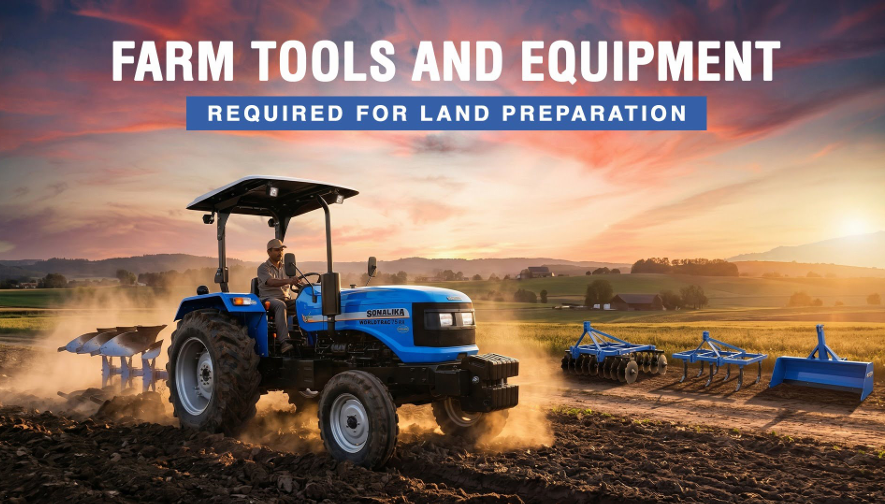
The right equipment for land preparation, aligned with your soil type, crop plan, & operational scale, is what distinguishes a productive season from a costly & unproductive one. Behind the scenes of every efficient land preparation operation is a capable, well-matched tractor for land preparation, driving your farming operations forward. Below, let’s discuss the most important & common farm tools used for soil preparation.
Land preparation is one of the essential chores in farming & plays a critical part in determining how successful a crop season turns out. This process helps to create the right physical conditions for seeds to germinate, roots to expand & crops to absorb nutrients effectively. Land preparation also breaks up compacted layers, incorporates crop residue in the soil & enhances water infiltration across fields.
A poorly prepared plot has increased chances of waterlogging, weed growth & uneven crop stands. From a farmer’s perspective, investing in the right farm equipment for land preparation reduces rework, per-acre fuel consumption & costs, & improves the lifespan of tractor implements.
Primary tillage is the first & deepest stage of soil working. It breaks fresh & compacted soil to set the foundation for land preparation. Here are the farm tools and equipment used for land preparation, used for primary tillage:
1. Mouldboard (MB) Plough
An MB plough inverts & turns the topsoil to bury crop residue and expose fresh soil layers. It performs best in loamy or clay-heavy soil where thorough soil inversion is required for the upcoming crop cycle.
2. Disc Plough
A disc plough is designed with concave discs to cut & turn the soil, making it highly effective if you’re working in dry, hard & stony field conditions. This tool can easily handle heavy, residue-laden plots better than MB ploughs & needs less draught power.
3. Chisel Plough
This farming tractor tool helps in disintegrating & breaking deep soil layers without inverting the topsoil, which in turn preserves surface organic matter. Chisel ploughs are widely used for subsoil aeration & is a common choice for fields with moderate compaction.
4. Subsoiler
A subsoiler enters deeper than a standard plough; often beyond 40 centimetres, to shatter hardpan layers that restrict root development & drainage. This essential equipment and machinery used for land preparation is highly effective for shallow tillage, but needs higher pulling power to maintain operational efficiency.
1. Harrows (Disc & Tine)
Disc & tine harrows break down residual clods after ploughing & produce a finer and more uniform seedbed. Disc harrows handle harder & compacted soil better, whereas tine harrows are more ideal for lighter soil & post-plough finishing.
2. Rotavator
Rotavators are commonly used agriculture tractor implements. It uses powered rotating blades to till, aerate & pulverise soil in a single pass, which notably reduces the number of field operations.
3. Cultivators
Tractor-mounted cultivators loosen the topsoil between rows, control early weed growth, & improves aeration without disturbing the seedbed structure. It’s highly versatile among tractor tools, used for pre-sowing & intercrop use.
4. Ridger
A ridger implement includes raised rows or ridges for row crops like maize, sugarcane, and potatoes. It assists by ensuring proper drainage management & is popular among farm tools for land preparation, often used in vegetable & cash crop farming.
5. Land Leveller
Land leveller, including modern laser-guided variants, helps in creating a uniform field surface that promotes even water distribution & reduces waterlogging. Consistent field levelling in large farms significantly improves irrigation efficiency & reduce water costs.
Selecting the right farm land preparation tool comes down to three practical factors: farm size, soil type & crop type. Here’s a quick operational comparison to help you come to a conclusion:
| Factor | Small Farms (Up to 5 Acres) | Large Farms (10+ Acres) |
|---|---|---|
| Primary Tillage Tools |
MB plough for loamy/clay soil Disc plough for hard soil & terrain |
Chisel plough or subsoiler for deep tillage & compaction management |
| Secondary Tillage Tools | Rotavator or tine harrow for seedbed preparation precision | A combination of disc harrow & cultivator for faster & wider coverage |
| Levelling Needs | Box blade or manual leveller | Laser land leveller, also ideal for mid-size paddy farms. |
| Tractor HP Range | 35-45 HP tractor, with more focus on handling | 50-75 HP tractor, focusing on power & more PTO power |
| Soil Type Consideration | Chisel plough, tine harrow & cultivator for loamy & sandy soil | Disc plough, disc harrow & sub-soiler for clay-intensive, compacted & terrain surfaces |
| Crop Type | Cereals & pulses | Row crops & cash crops |
| TCO Focus | Multi-use implements for lower capital investments | Purpose-matched implements for efficiency & precision |
Doing land preparation the right way starts with selecting the right farm tools and equipment used for land preparation & using them correctly. Every implement you equip to a tractor for land preparation should justify the cost through measurable improvements in seedbed quality, fuel efficiency & crop output. If you’re looking for reliable, durable & high-performance farm equipment and machinery used for land preparation, explore our full range at Sonalika FAMAG.